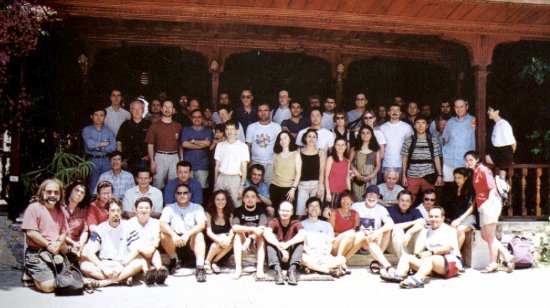
Invited speakers
| D. Auroux | |
Y.-G. Oh | |
J. Bryan | |
B. Siebert |
| A. Stipsicz | |
P. Ozsvath | |
R. Gompf | |
R. Fintushel |
| Y. Eliashberg | |
R. Matveyev | |
B. Ozbagci | |
A. Bertram |
| D. Freed | |
P. Feehan | |
G. Mikhalkin | |
I. Smith |
| R. Donagi | |
J. Sawon | |
B.-L. Wang | |
G. Matic |
| A. Petrunin | |
S. Salur | |
| |
|
Scientific Committee : G.Tian, R.Stern, C. Vafa, R.Kirby, S.Akbulut
Organizing Commitee : T. Onder, T. Dereli, S. Kocak, S. Finashin
| Aaron Bertram |
Counting rational curves and localization |
| Justin Sawon |
TQFT and hyperkähler geometry
Rozansky and Witten proposed a 3-dimensional sigma-model whose
target space is a hyperkahler manifold. They conjectured that this theory
has an associated TQFT, with Hilbert spaces given by certain cohomology
groups of the hyperkähler manifold. On the other hand, there is a
certain modified TQFT constructed by Murakami and Ohtsuki using the
universal quantum invariant. We explain how the Rozansky-Witten TQFT can
be obtained from the latter by applying a "hyperkähler weight system"
|
| Yong-Geun Oh |
Floer theory and geometry of Lagrangian submanifolds |
| Grigory Mikhalkin |
Decomposition into pairs of pants in higher dimensions
A useful tool to study Riemann surfaces (complex 1-manifolds)
is their decomposition into pairs of pants. Each pair of pants
is diffeomorphic to CP1 minus 3 points.
In my talk I show that any hypersurface in a toric variety admits
a similar decomposition. The higher-dimensional version of a
pair of pants is CPn minus (n+2) hyperplanes. The first interesting
example is a decomposition of a quintic surface in CP3 (an
irreducible 4-manifold) into 125 "pairs of pants".
|
| Aaron Bertram |
Counting rational curves and localization II |
| Dan Freed |
The Verlinde algebra revisited |
| Sema Salur |
Special Lagrangian submanifolds |
| Peter Ozsvath |
Holomorphic discs and 3-manifold invariants |
| Gordana Matic |
Tight contact structures and taut foliations |
| Denis Auroux |
Symplectic maps to projective spaces and applications |
| Ron Donagi |
G-bundles, hyperkähler manifolds, and stringy Hodge numbers |
| Jim Bryan |
Multiple covers, BPS states, and integrality in
Gromov-Witten theory
The Gromov-Witten invariants of Calabi-Yau 3-folds have
been conjecturally related to the numbers of certain BPS states in
M-theory by the formula of Gopakumar and Vafa. By computing the
contributions of multiple covers of a rigid curve in the 3-fold to the
Gromov-Witten invariants, we study and verify this conjecture in series of
natural cases. This also sheds light on the relationship between the
Gromov-Witten invariants and the enumerative geometry of the 3-fold.
|
| Bernd Siebert |
The symplectic isotopy problem |
| Burak Ozbagci |
Commutators, Lefschetz fibrations and the signatures of bundles |
| Andras Stipsicz |
Lefschetz fibrations: properties and applications |
| Sergey Finashin |
Exotic knottings of surfaces in CP2 |
| Robert Gompf |
Topologically characterizing symplectic manifolds |
| Ivan Smith |
Lefschetz fibrations and the moduli space of curves |
| Paul Feehan |
Non-abelian monopoles and Four-manifold invariants |
| Rostislav Matveyev |
Lefschetz fibrations on S1xM3 |